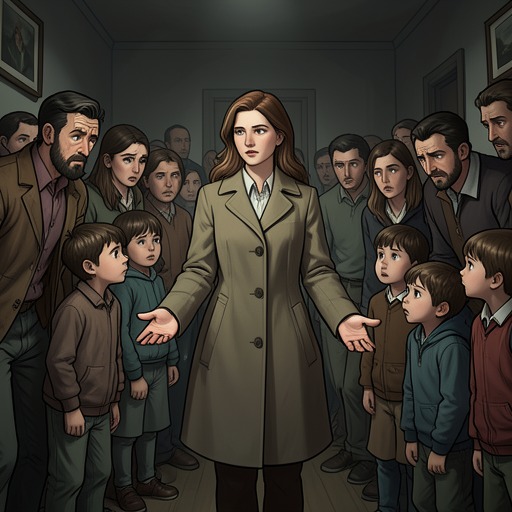
Orphanage
I’m Very Happy After Marrying the CEO Husband According to the AgreementThe Orphanage is not merely part of Shen Tang’s backstory; it is the social world that explains why money, work, illness, and family carry such weight for her. As a home for children who have been left behind, especially those whose disabilities reduce their chances of adoption, it embodies both the security of found family and the structural vulnerability of people whom society has already classified as difficult to place. Shen Tang’s connection to it transforms the apparently glamorous story of a scandal-ridden entertainer and contractual wife into a narrative about care, obligation, and the cost of protecting people with little institutional power.
Definition and Social Position
The Orphanage is a financially fragile institution populated by children who lack conventional family protection. One of its children, an eight-year-old boy regarded by Shen Tang as her younger brother, contracts leukemia and requires an expensive operation. The crisis makes the orphanage’s precarious condition concrete: it has little money to begin with, and the children who remain there are not simply waiting for ordinary adoption opportunities. The narrative explicitly links their continued residence to disability, since only children without disabilities can be adopted while those left behind carry some form of disability.
This arrangement places the Orphanage within a social system that treats adoptability as a measure of worth. Its children are defined not only by their need for care but by the barriers that prevent them from entering a conventional family. The institution therefore functions as both shelter and evidence of exclusion. It preserves a communal family for children whom the outside world has failed to absorb, while its poverty exposes how little protection is available when care depends on limited charitable resources and the sacrifices of individuals.
Shen Tang’s Connection and Responsibility
Shen Tang’s relationship with the Orphanage is rooted in shared childhood rather than blood. The sick boy is not her biological brother but a child from the same orphanage, and yet she treats him as family, responding to his affectionate address of her as Sister Tang with immediate tenderness. The distinction between biological and chosen kinship is central to the location’s meaning: the Orphanage is where family is formed through shared abandonment, long familiarity, and acts of care rather than through legal or genetic ties.
The original Shen Tang’s ambition to become successful and earn substantial money has a double purpose. She wants a better life for herself, but she also wants to improve the living conditions of the children at the Orphanage. This motive revises the public image imposed on her by the entertainment industry. Her reputation presents her as a scandal-producing burden whose company pairs her with every male celebrity to profit from attention, while her private financial goal is connected to children who cannot easily advocate for themselves. The contrast gives her ambition a practical ethical foundation rather than reducing it to vanity or celebrity hunger.
Money, Illness, and Acts of Care
The leukemia diagnosis exposes how dependent the Orphanage is on Shen Tang’s limited resources. Over the years, she has gradually poured her savings into helping the institution. By the time the child needs surgery, she is essentially penniless apart from the money recently provided by her contractual husband. Her attempt to secure help from Wang Brother fails because he claims to have no spare money after buying a house, leaving Shen Tang to confront the gap between the entertainment industry’s rhetoric about opportunity and the absence of dependable support when a child’s life requires immediate funding.
The contractual marriage changes what she can do. Under the marriage agreement, Shen Tang receives five million per month, has her living expenses charged to her husband’s card, and is promised a settlement of two hundred million when the two-year agreement ends in divorce. These terms give her access to resources that her previous career could not reliably provide. Rather than treating the arrangement only as romantic or financial comedy, the narrative connects it directly to the Orphanage’s needs: the money becomes a means of converting an artificial adult relationship into concrete medical and communal security.
When Shen Tang visits the hospitalized child, she encounters him pale-faced but remarkably well behaved. His affectionate greeting moves her, and she responds through decisive material intervention rather than consolation alone: she transfers him to a premium suite and hires a special caretaker before leaving. The gesture reveals her characteristic form of care. She does not merely express pity for the children; she uses whatever economic power she has acquired to alter their immediate conditions, even when the expenditure threatens the reserves she had accumulated for herself.
Narrative Significance
The Orphanage gives Shen Tang’s identity a counterweight to the public spectacle surrounding her. On camera, she maintains a professional smile while black fans flood her livestream with insults, and the company profits from the attention created by scandal. The stream itself promotes agricultural products from remote mountainous regions, showing another version of commercialized care: public sympathy and consumer attention are organized into revenue. Against that platform-driven performance, the Orphanage represents care whose value cannot be measured by popularity, trending status, or publicity. Its needs persist whether Shen Tang is praised, mocked, or ignored.
The location also complicates the distinction between personal and institutional responsibility. Shen Tang’s manager urges her not to abandon entertainment, arguing that even bad publicity is still publicity and recalling her earlier desire to earn money for a house and for her siblings’ living environment. His language treats visibility as a scarce professional resource, whereas Shen Tang’s experience of the Orphanage shows that money is scarce in a more literal and urgent sense: a child needs surgery, and the institution cannot absorb the cost. The conflict makes her career decision inseparable from the care economy surrounding the children.
Although Shen Tang has lived alone across two lifetimes, thoughts of children repeatedly awaken her desire for family and belonging. The Orphanage is the clearest existing form of that family. It connects her to a group whose members are not bound to her by blood but whose vulnerability calls forth durable loyalty. In this sense, the Orphanage is both a physical refuge and a moral compass. It explains why Shen Tang can endure public humiliation for income, why illness affects her decisions so strongly, and why financial success matters most when it can be redistributed into protection for those society has left behind.